


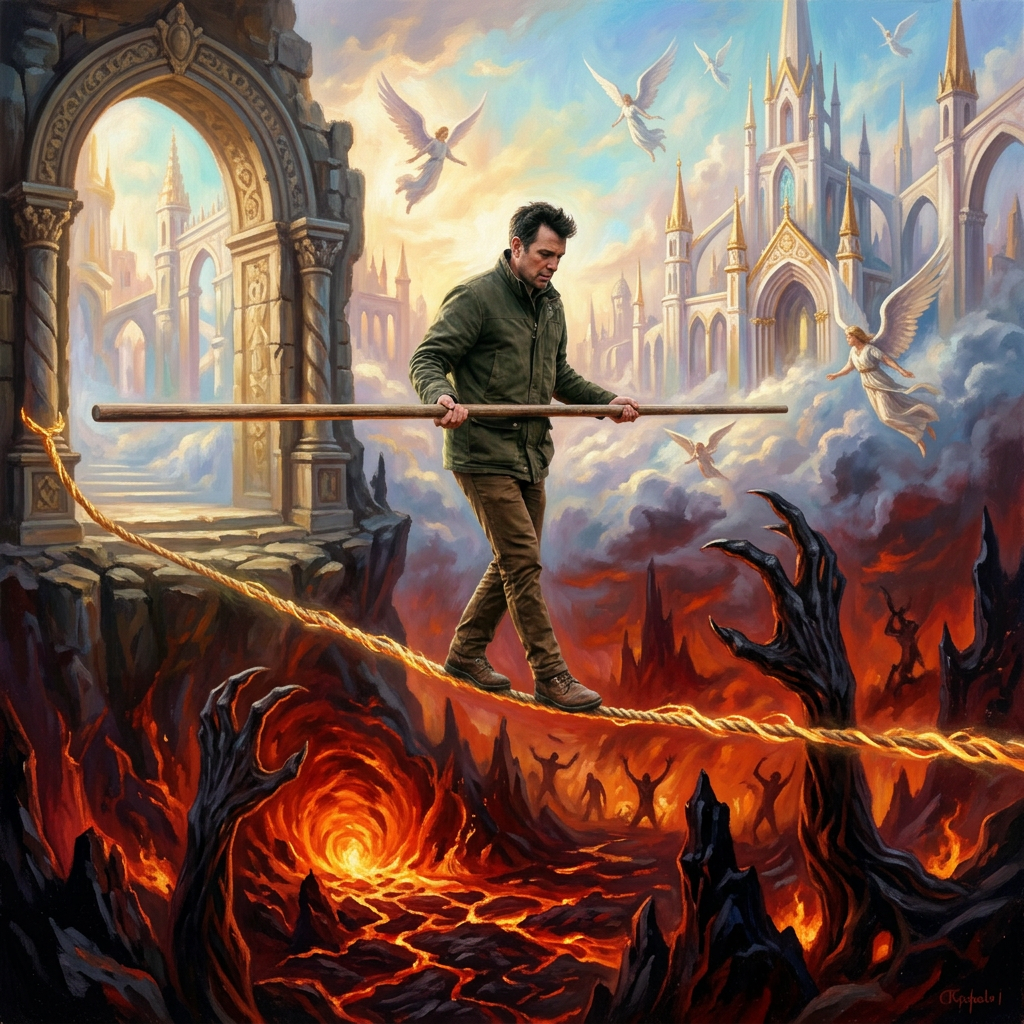
How do I handle uncertainty? A balanced toe on a thin thread of braided fate, chance, and providence: Each woven one at odds with the other. Careful still of gravity, disguised as my control.
How do I handle uncertainty? A balanced toe on a thin thread of braided fate, chance, and providence: Each woven one at odds with the other. Careful still of gravity, disguised as my control.

“All that stuff about the Cosmic Sadist was not so much the expression of thought as of hatred. I was getting from it the only pleasure a man in anguish can get; the pleasure of hitting back.” C.S. Lewis, A Grief Observed
From the depths of utter despair sits the loneliest man beneath the constant storm of grief. Raging winds of desperate sadness. Pounding rain of despair. Crashing thunder of fear. Dripping wet with self-hatred, the cold discomfort is at least feeling something the hole in his heart cannot devour. If anything might assimilate the emotional experience of our grief with a physical representation, it must be that of a storm. The sudden rising nature, seething momentum of approach, relentless surging with intermittent moments of quiet reprieve and false hope before it’s wrath returns again. Yes, it stinks of the commonality with grief except it’s occasional beauty that can be appreciated from a covered porch or beneath a warm blanket on the couch. There is no such beauty in grief. No such sanctuary from it’s elements.
It sounds like anger, too. But anger is only a symptom of the storm- the clapping loud thunder that startles us from our seat and shakes the windows to our soul. It is the rising flood, an unwelcome guest in our home, the leaking ceiling that suddenly collapses beneath the weight. Anger. So much has been made of a misunderstood secondary emotion. Our panic and anxiety and fear, they all get mistaken for anger all of the time. But in grief, this anger comes from the deepest part of the soul. From the depths of whatever spark of creation existed before us. Primal. The gnashing of teeth, the tossing of the temple tables, the casting out of an arch angel. This anger is part of grief. And perhaps it is where you are at now but not where you will be tomorrow. The only certainty is that it will rise again.
But there are many lies about grief and anger. The truth that there are healthy ways to relieve it get’s muddled by every person with a keyboard and an opinion telling us that its a hot coal that burns us. Likening it to the drinking of poison, uselessness, dangerous- as if it were a damned choice. The only thing more maddening about anger is someone, in their comfy peaceful perch looking in from the outside, claiming we should drop our anger and join them out there in the real world where you no longer exist. You might as well be speaking from another dimension. Welcome are those few people who have felt such great grief before, who recognize your place, who see the storm around you and fear it as they once survived what they care not to endure again, and offer the advice of no advice. They offer encouragement. Feel your anger rise and understand it’s place. Anger has to emerge and find a target. You cannot keep it to yourself- and therein lies it’s danger.
No person deserves to feel the anger that torments you. So, choose your target wisely. It is natural to target God. Especially, when you choose to seek only him in your loss. Exactly what scripture leads you to believe will be your saving grace: a sole dependence on God. So you turn there in an act of obedience. And at no moment will you feel the silence of a closed door more than, very often, that moment you show up at his doorstep. Eventually, you move from: take this pain from me, to please stop letting them hurt me, to please stop hurting me, to…striking back.
But perhaps if we serve a God as big as every person hopes a creator will be, he can take our anger. Take our wild swings, our screaming, our crying, as we crash into him with the hope that he will take hold of us until the violence ceases and we are reduced to crying in his arms. Anger in grief is not a choice. Our target is. Exercise, art, writing, our pillow, our God…they are safe. The person who hurt us doesn’t need to be hurt back. The person we hurt doesn’t need more hurt. It will provide us with nothing but more emptiness. Living creatures are not an outlet, our pillow is. “Instead, be kind to each other, tenderhearted forgiving one another, just as God through Christ has forgiven you.” Ephesians 4:32. “God blesses those who mourn, for they will be comforted.” Matthew 5:4. And the anger that comes in waves is a natural part of your mourning.
Everyone who grieves feels the sting of shame and judgement. Everyone who is familiar with grief feels anger. Grief is not a course of linear steps. It is a waxing and waning, a back and forth, the rise and the fall of the tides of the ocean of despair. Anger will rise and it will fall. It is not a reason to feel more shame. But it is a hammer that can destroy more of the reality around you. So, we must be careful where we swing. We must find something that doesn’t feel pain to absorb it’s energy, or someone big enough to know what to do with it. And no living creature is big enough to deserve absorbing our own anger. But God is. And so is your pillow.
“I sat with my anger long enough until she told me her real name was grief”. C.S. Lewis

What’s a moment when you realized you were officially an adult?
When every decision held a consequence. Responsibility became a purpose. When God died and was reborn more real 10 times before I found an answer. When I held my children. When I found true love. When I lost them all and found I was still breathing despite my every best effort. When I kept moving despite life. Mostly, when I became grateful for it all.

Sunday sidebar’s are strictly for me. They are a moment I am not apologizing and owning all of the responsibility. A moment where I don’t need to connect to someone in need. A moment this is not a ministry, a project, a journey, a creation. Sunday sidebar’s are my moment to spill my feelings without second thought or edit. The silent and embarrassing thoughts that keep me from my sleep. They are for me. Remember me? The one who broke your heart? The one who you condemned without a second thought or single conversation. The one you publicly shamed. Stripped bare. Walked away as if I was nothing. As if I was living a lie. As if I hadn’t been an amazing person, friend, or husband. How easy to not judge the ones you call family and friends and strangers for their worse moments- a moment of need made opportunity of abandonment.
Festering beneath the guilt and shame, like great tectonic plates shifting, sliding, grinding, carrying the weight of my faults and my mistakes- anger. The person who claimed to know me, who coaxed my most vulnerable self, who preached for sensitivity and emotional availability- what was actually needed was me to be there for her darkest self but be careful in sharing my own. Walked away as if I was a gum wrapper beneath a strangers shoe. Every hope and dream you set in flames and blamed every ash on me. Searching solace in every person, calling the peace you have in your heart from God- may God give you that peace despite putting your decisions on him. As if he brought me peace for my mistakes. No, that was wrath. Divine punishment. Not peace. And yet this anger gets but a second notice and my sadness at your absence owns my daily life. My prayers for your happiness out number those for my own. While you hate with a cold heart.
Great pain does one bring who testifies their need for honesty while using self lies to bring about their own peaceful life.
Closure? Closure is death for most human souls. Hope? Hope is an afterlife free from pain. But if God is so keen for us to suffer here how are we so certain suffering does not await? He is always faithful to his promises but no promise is earthly. So hope is only in what awaits that which we do not know.
Anger is fleeting and overlies my fear. It vanishes as quickly as it came, but the fear remains. The desire to be whole again, the reality I will not, and my only prayer that the person that took everything that made me human will remain happy, safe, and whole- that is the reality of life. But the small glimpses of beauty- the stars, the trees, the approaching storm clouds, the sound of laughter- keeps my hope in God as my memory of what was the most beautiful fades away day-by-day.
“Talk to me about the truth of religion and I’ll listen gladly. Talk to me about the duty of religion and I’ll listen submissively. But don’t come talking to me about the consolations of religion or I shall suspect that you don’t understand. … Reality never repeats. The exact same thing is never taken away and given back.” C.S. Lewis, A Grief Observed
In the opening of the brilliant novel, The Goldfinch, by the literary genius, Donna Tart, the young Theo Decker finds himself in a tragic and sudden transition from the safety and freedom of a loving mother to the literal and figurative aftermath of an explosion in an art museum: left confused, surrounded by the rubble of walls, ceiling tiles, dust, smoke, and body parts he is thrust into a lifelong journey through grief. Walking into the museum that day his mind never ventured to imagine life without his mother. Why would it? As he wandered and worried about the trouble he had caused in school and the disappointment and anger his mother may have, his thoughts never led him to believe at any moment it would be his last opportunity to say good-bye, or I love you, or I’m sorry. He couldn’t imagine the guilt of leading his mother into that museum or the pain of losing her. For days he sat in the apartment certain the phone would ring and it would be her, she would walk through the door with dinner, seeing her, hearing her, smelling her. First a constant sea of denial followed by waves of remitting and recurring denial, anger, sadness, shock…always an underlying fear.
Denial is not a large body of water. It’s not even fluid. It is the small raft your mind strands you upon in the midst of terror and loss of reality for the sake of survival. The edges of that raft, it’s borders and size, are simply determined by what your mind can handle in the moment. An emotional buffer between the safety of your previous reality and the new reality of loss and pain. In the aftermath of tragedy everything slows down to a survivable pace- the silence of the house, the growing pile of dishes in the sink, the sounds of the settling house and the clock on the wall. Tick, tick, tick, tick… We move slowly, we breath slowly, we wait for that person to call, walk through the door, seeing them, hearing them, smelling them.
That is denial. A slowing of the pace of reality: the brains desperate attempt to restrict how quickly the painful realizations of your new life are absorbed, like a nozzle on a firehose. But there is no permanent comfort on this small raft. While it may protect us in those early days, to stay here and dine on the lotus flower of Calypso’s island is to damn yourself to a life of pain and sadness that will live forever beneath the surface, giving way to an even greater loss- our souls.
In the movie, Braveheart, William Wallace is visited by his deceased wife, the love of his life, during a dream. There is something sad, sweet, and very real how he begs for her to remain when he says: “I don’t want to wake. I want to stay here with you.” Her reply is what God is telling us softly with each growing day: “And I want to stay here with you. But you must wake up.” His reality is no longer there with her and his journey must go on, he must fight, fueled by her memory but not remaining there, defenseless, within it’s company.
I believe C.S. Lewis was right, and that his gutted portrayal of his grief is amongst the greatest in literary history, when he said don’t come talking to me about the consolations of religion, what was taken away will never be given back. That is the underlying etiology of the fear beneath our guilt and grief and why we find ourselves in denial. We don’t want to wake up. We don’t want to say goodbye. The only quiet glimpse of consolation during this period of loss is the silent image of the cross, the hope in a Savior, a garden of prayer. And all of those things are still fleeting for some great time. Waves of consolation broken on the rocks of a sudden memory. But if you are to step off that raft and try to fight, to continue your journey, it will be those moments of His consolation that may sustain you the most. You will never rid yourself of the pain. You are hurting even when you deny it exists. You will hurt when you open your eyes and rummage through the pieces, too. That pain, if you were genuine in your love, will remain: you cannot rid yourself of it, you must change your relationship with it.
“I will never forget this awful time, as I grieve over my loss.” Lamentations 3:20. “Though he brings grief, he also shows compassion because of the greatness of his unfailing love.” Lamentations 3:32
When you are ready to look around at your new reality, start by sitting on the edge of the raft with your feet in the water. Feel each emotional current pulling and pushing. And ask God to be with you before you are submerged and swimming toward the shore. Ask him to remind you that your feet will stand on solid ground again. Move. Stroke. Fight. And breath.
“No tree, it is said, can grow to heaven unless its roots reach down to hell.” Carl Jung
Before we start this journey together regarding surviving our loss and dissecting the evolution of grief, it is necessary to first take the most difficult step: identify exactly what we are grieving. Grief isn’t a vague process that proceeds through natural stages on its own, and if we do not say out loud what we lost and what we mourn then we will become stuck in any particular phase of grief; a breeding ground for what you might call “past trauma” that one day wreaks havoc on the future. And since this step is so important and perhaps the most difficult, and because in writing it I feel like a bit of the pot calling the kettle black…I’ll share my own pain biopsy in hopes that some vulnerability is both therapeutic and beneficial to someone out there somewhere, as well as, myself.
Do not be surprised to find that taking ownership of your own mistakes and faults, as well as identifying the hurt you caused, may be easier than identifying the non-organic specific losses and hurt. Unless your loss is due to a death, we have blame to accept. And we will. The journey we took to the bottom, however, led us to care so little for ourselves that it made self-judgement and conviction much easier than acknowledging the broken promises or physical losses that we now mourn. But if you are going to grieve and have a hope of healing, admit what you are grieving- a step in the right direction of honesty is being honest with yourself. Carl Jung said, “There is no coming to consciousness without pain”, and “One does not become enlightened by imagining figures of light, but by making the darkness conscious.”
The pathology of our pain and nearly every stumble we have ever faced is rooted in fear. The most amazing humans have made the most horrible mistakes. And those who look amazing without fault have only hid them well and acknowledged them less. It is much easier to assume a persons identity with their worse moments while seeing our own identity as our greatest attributes. In other words, our assumption of a persons identity is often dishonest and our assumption of our self identity is often honest. That is until you find yourself in the ashes and all you are able to see is all of your ugly parts. The entire system flips on its head along with every other thing in your life. Self loathing. Self distrust. Self hatred. And therefore, flows the ease of accepting your mistakes and the difficulty in naming the things you are grieving most.
Two things come to mind that lead to painful grief. One is the loss of something vital to you. Death of a love one. Separation and divorce of your person. A prodigal child. You have no control of any part of the loss. You cannot bring someone back to life. You cannot make someone love you. You cannot change a persons will to make bad choices. The other is the loss of something that confirms your insecurity. Abandonment. Distrust. Feeling unsafe. All of the insecurities. And a successful pain biopsy must address both types. Both are often tied together. You not only lose your spouse or your child, you lose every hope and dream woven into the fabric of your previous reality. And that is exactly why it hurts so badly, for so long, and why we get stuck in the worse of it.
For example, the severity of my pain seemed obvious to me at first. I lost the love of my life. Similar to having an argument, causing them emotional pain, and then moments later they die in an accident- you never see them again, you never get to say you are sorry, you never get the chance to rebuild what was broken into something greater and more indestructible. Only in this case (and thank God, of course), it wasn’t an accident. And while those wounds remained open the person who I loved the most in this world was out there moving on and healing without me- her sworn best friend, husband, safe place- replaced with worse friend, ex-husband, unsafe person. When the person you love more than any human in your lifetime disappears you feel like you are perpetually stuck in the initial moments after the fall when the wind has been knocked out of you- gasping for breath, chest tight, panic, fear. I was mourning my greatest loss. A person. And that part will stay with you forever. But that can become more generalized with time and confusing and the pain seems to worsen instead of easing and become manageable. The biopsy only included the largest lesion. And with that lesion were the metastasis that turned up at every dark corner of my heart. I not only mourned a person. I grieved deeply for our time. Early mornings, dinners after work, random texts, sending flowers, planning our weekends, cuddling on the couch, reading in bed and hearing her breath and feeling her cold feet. The small things began to add up to seemingly infinite losses. Sitting in the bathroom while she showered and vented about her day, dinners with her family, walking the dogs, jump scares and pranks, teamwork, dancing in the kitchen, sharing a song. But it didn’t end with the direct losses that shunted off of the experiences with the person. It included our future. The dream and planning to bring a child into the world. I mourn the loss of child that will never be born. Finding our “forever home”. Dreaming of pets and farm animals. Dreams of travels and adventures. And I mourned my final day, just before my final breath, when she would hold my hand and say “we did good”. I mourned promises lost and broken, of lifetime together, and for better or worse and sickness and in health. And after weeks of identifying those individual things we grieve, only then can we begin to say goodbye and hope for healing.
There is no recipe to feel better. And our greatest misconception is that time heals all wounds. It doesn’t. In fact it makes them worse. Every trauma you carry with you was time not healing a wound. Stuck in the cycle of grief. Intention, steps forward, feeling the pain, hard work, praying, and the mercy of God are the only hope we have of healing any wound. A pain biopsy is painful. But the only way through loss and grief is the eye of the storm. You must travel directly through the storm, walk through hell, to get to safer ground. There was a point in the movie, The Odyssey, that resonated deeply with me in regards to this very point when Calypso is seeing Odysseus off on his makeshift raft heading home over uncharted waters. What she says describes what we must eventually face on our journey if we want to get home. And it is a lesson that an attempt to control every outcome in the pit of despair will only prolong your suffering.
“You are a man that likes to control your fate. But this time you can’t. You must give yourself to the storm. Give yourself to Poseidon. Take your punishment.”
A pain biopsy is painful but necessary. You don’t just grieve, you grieve the loss of many specific things. And failing to identify them and not allowing yourself to feel the pain will lead to getting stuck. And those demons will show themselves again in many forms years down the road. So, take a deep breath, do an inventory, hold on tight, and biopsy.

“No one ever told me that grief felt so like fear. I am not afraid, but the sensation is like being afraid. The same fluttering in the stomach, the same restlessness, the same yawning. I keep on swallowing.” C.S. Lewis, A Grief Observed
A shocking truth about grief and mourning is that it is a chronic disease. That mourning resembles the time of day only as a heterograph, but better approximates eternity as a synonym, is undesired irony. The clinical picture is constant aching pain with fluctuating intensity described as waives of aching and stabbing pain, nausea, lightheadedness, and emotional lability. There is the inability to eat or sleep despite the oppressive weight of fatigue and sudden loss of motivation to get off the couch. And yet, we are expected to wake up each morning, go to work, take care of our family, maintain our health, concentrate amidst constant uncontrollable waves of memories that tear at the edges of our gaping wound of loss. This is the misery of grief, that in moments as time progresses we try to convince ourselves that we will be okay and that life will move on. We will string together, at first, a few minutes to hours of emotional reconciliation: only to, unprepared and unaware, be speared into pieces by a sudden fleeting memory. Sometimes it is triggered by something you shared together. Sometimes it arrives like a thief in the night to rob you of your will to live. There is no good mourning. There is no sensible mourning. Grief is the most painful human emotion, but is the least human experience.
Perhaps it feels the least human because it is the emotion that brings us closest to God. Or, as we often feel in the moment, the absence of God. Either way, whichever side of the spectrum you find yourself from one minute to the next in these volatile circumstances, it is when one cannot help but at least desire a divine presence. Help. Comfort. Peace. Deliverance. Forgiveness. Healing. Resurrection. Death. I am wary to offer the word blessing behind any intention of grief, for blessings are unwelcome in a cloud of darkness so thick. However, perhaps the mechanism behind the pain could be an eventual choice of blessing rather than immediate gratification of death. It is during the early moments of grief and mourning that we tend to underestimate our worth in this world the most. We made enough mistakes, don’t make that one.
There is one constant in our mourning during grief. A deep void, or absence, left in our entire being. By entire being I mean this sensation of a missing piece is experienced physically, emotionally, spiritually, mentally. As the primary result of the massive portion of our being ripped from our chest, we experience indescribable pain. I believe that is why denial, the first phase of grief we will soon explore, is the most logical and desperate starting point in a rush to self preserve. Our whole world construct, the entire reality of the life we created, has just collapsed into the ashes in a single moment. If our reality ceases to exist, so does our acceptance of the circumstances. We deny that reality exists, after all it no longer does as we conceived it, and we rush to fill that void desperate to stop the hurt.
I was told by someone the fastest way to get over someone is to get under another. What a desperate false hope. Adding a poison to an open wound. Taking the few remaining pieces of your soul and giving them away until the void covers you in entirety and you are unrecognizable as a person. I have felt, myself, the desire to use alcohol or drugs to manage the pain. A liars crutch. Adding more chaos to chaos. Pouring gasoline onto a raging fire. No, there is nothing that is big enough to fill that void, that undesired painful emptiness, except something greater than our human experience. There is nothing big enough to fill that void but God. And perhaps that is evident, at our lowest, when we first feel the unimaginable pain of loss and we rush to pull ourselves from the fire that we so often think, God help me. Perhaps it is the spark of the divine that is written in our very DNA that points us to the only real answer. Perhaps, when everyone you loved has turned away and all is lost, God is the only one left beside you. And perhaps it is because He is reaching for you, pulling you in, because this terror is real but so is He.
God is not the absence of mourning. “I dress the skies in darkness, covering them with clothes of mourning.” Isaiah 50:3. He is the hopeful presence among it and the pathway beyond it. “You have turned my mourning into joyful dancing. You have taken away my clothes of mourning and clothed me with joy.” Psalms 30:11. There is no doubt that this pain will be remembered for a lifetime. But a life is both too short to remain in our darkest moments and too long to be defined by it. God understands this is the most severe and complex human emotion. He understands this pain is more than we can bear. Sometimes, the severity of the pain is unnecessary and if only the other person involved would look to God in the same way it could be healed and joyous. But their will is not yours and their needs are their own. Sometimes, the other person is no longer living and you are left to heal without the hope of their return. Whatever it is, however it came about, our first lifeline is that despite our greatest loss God will continue to write our story. Take comfort in that He is an author who only writes happy endings for those characters that choose His pages.
There is no good mourning. The pain that comes with grief will dissipate, but even now as I write, memories and fears of the person I lost come and go and feel as real and painful as the day it occurred. They may be dead, or they may have moved on, they may have patched their void with another person, place, or thing. But your hurt is uniquely yours. And it is going to show itself for a longtime to come. So our focus belongs not on the fears but on the only hope we have in the person of Jesus Christ. If we gain anything from the ashes of this fire it is that we are not our few mistakes. We are the children of God who have loved deeply, cared freely, grown immensely, and are of the highest value to the Kingdom of our creator. Why else would he be the only one there in our minds when we look up from our greatest tragedy.
The cost of love is grief. The cost of anything worth having is great. And when we realize that cost it is only natural to feel bankrupt because we don’t have the resources to manage this type of transaction. But that high cost of pain can be covered on our loving Father’s account. No strings attached. No interest. Paid in full before you were ever born.

